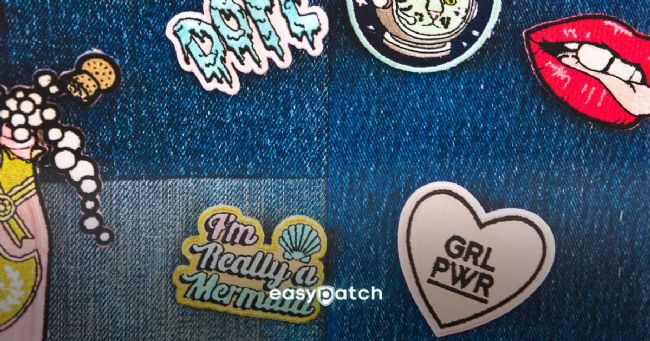
If you are thinking of creating custom embroidered patches for your brand, a sports group, an association or simply to give character to your garments, it is normal to wonder what exactly they are, what types exist and how they are produced.
In this guide you will find a comprehensive overview, based on the features and production process used by a company specialising in customised patches like Easypatch, so you can make informed decisions without improvising.
Custom embroidered patches are textile inserts made of embroidered threads on a fabric backing. They can bear logos, text, symbols and graphics and are applied to clothing and accessories to communicate identity, belonging and style. They are widely used on jackets, caps, backpacks, uniforms, technical and workwear, but also for collectors' items, event mementos and personalised gifts.
Types of customised embroidered patches
When we talk about embroidered patches, we are not talking about a single product, but about a range of different solutions, designed for specific aesthetic and technical needs. In particular, we can distinguish three macro categories: standard embroidered patches, 3D embroidered patches and HD or micro-embroidered patches.
Standard Embroidered Patches
Standard embroidered patches are the most 'classic' version. The design is realised by embroidering coloured threads on a base fabric, resulting in a well-defined two-dimensional effect. They are perfect for company logos, lettering, emblems and symbols with a good level of detail, and are available in many colours for both the base and the thread.
If you want a patch with a traditional feel and a clean, professional look, the standard embroidered patch is the natural starting point. The combination of backing fabric and embroidery gives the garment a neat and durable appearance.
3D embroidered patches
3D embroidered patches add an extra level of depth. In this case, a layer of foam material is inserted underneath the embroidery, resulting in a relief that is perceptible both to the eye and to the touch. The result is a logo that 'emerges' from the fabric and becomes even more noticeable.
To achieve the 3D effect, minimum thicknesses and sufficiently large embroidery areas are required in order to accommodate the filling material. This is an ideal solution if you want to strongly emphasise certain parts of the logo, such as initials, symbols or simple but striking graphic elements.
HD / micro-embroidered patches
HD embroidered patches, often called micro-embroidery, represent the highest level of quality in embroidery. They are made with a very high quantity of fine threads, which allows complex graphics to be reproduced with great precision, very defined lines and clean contours.
This type is particularly suitable when the logo contains small details, minute text or elements requiring high legibility. In order to achieve an optimal result, it is important to comply with certain technical requirements, such as a minimum thickness of the strokes and the use of solid colours without gradients. In return you get a patch with an almost 'printed' look, but with all the robustness of embroidery.
Customisation possible: shape, border and back
One of the reasons why custom embroidered patches are so versatile is the wide variety of options you can choose from. You are not limited to the logo: you can decide on the shape, finish and method of application.
Patch shape
The shape can be completely customised:
- regular shapes such as circles, squares, rectangles, shields and triangles
- contoured shapes that follow the outline of the logo or graphic
During configuration you can indicate the dimensions in millimetres, choose a standard shape or request a special shape. If you already have a file with the outline, it is used as a reference; alternatively, the outline is defined by the graphics department based on your logo.
Border and finishing
The finishing of the border has an aesthetic and functional role. In general you have two main options
- laser-cut border, which precisely follows the contour of the patch and keeps the surface completely flat
- embroidered border, i.e. an embroidery frame around the perimeter, particularly suitable for simple shapes such as circles, shields or rectangles
In both cases, minimum thicknesses and safe distances from the graphics are respected, so that the embroidery does not encroach on the logo and the border is defined and regular.
Back: how you want to apply the patch
The reverse side is the part that most affects how you want to apply the patch. Depending on the end use, you can choose from various solutions:
- neutral back to be sewn on, with a groove along the edge that facilitates sewing on clothing and accessories
- heat-adhesive or heat-sealable back, which allows the patch to be applied with the heat of an iron or press, following the recommended times and temperatures
- Velcro back, often with male Velcro on the patch and female Velcro to apply on the garment, for removable fastening
- adhesive back, allowing quick cold application to suitable surfaces
- back designed for conversion into gadgets, such as key rings or magnets
This flexibility allows you to adapt the same design to different contexts of use, e.g. work uniforms, casual wear, backpacks or promotional accessories.
Special effects and combinations
Custom embroidered patches do not stop at the 'standard' version. You can add effects and combinations that make them even more distinctive.
Among the most common variants are
- 3D relief embroidery on selected parts of the logo
- special threads, such as metallic gold or silver threads, to give a more prestigious touch
- bright and fluorescent variants, making the patch highly visible in low light conditions
- transformation into a key ring, using the same graphics as the patch
- combination of embroidery and printing on fabric, useful for graphics with many colours or complex details
In this way you can decline the same design in different versions, maintaining visual coherence with your brand but adapting to different contexts of use.
How to design a customised embroidered patch
To achieve a truly effective customised embroidered patch, it is not enough to have a logo. You need a minimum of design, especially if you want to make the most of the technical possibilities of embroidery.
A typical design process involves a few key steps.
- Define use and size
First ask yourself where the patch will be applied. On a work jacket, on a cap, on a backpack or on a sweatshirt? Depending on the intended use, the ideal proportions and dimensions change. A cap patch will be smaller in size than a jacket back patch.
- Choose the shape
Depending on the logo and style, you can opt for a regular shape or a customised shape. Regular shapes are more 'tidy' and often easier to manage on many different garments. Custom silhouettes enhance logos with characteristic silhouettes more.
- Adapt graphics to embroidery
Embroidery has precise limits on minimum thicknesses and details. It is important to simplify lines and micro elements that could get lost, especially on small sizes. In micro-embroidery, a minimum thickness of the strokes is required, beyond which the details remain legible. If your logo was created for digital, a dedicated graphic intervention may be useful.
- Select colours and combinations
Custom embroidered patches offer a wide range of background and thread colours. The choice must take legibility into account: light text on dark backgrounds, or vice versa, sufficient contrast between neighbouring elements and fidelity to the brand's institutional colours.
- Deciding on border and back
If the patch is to be sewn on technical garments, the back to be sewn on is a solid choice. If, on the other hand, you want a quicker solution, the thermo-adhesive back or Velcro may be more convenient. The border, embroidered or laser cut, completes the look and protects the perimeter.
If you do not have a file ready for embroidery, you can rely on an in-house graphic service, which will clean the file, prepare the embroidery layout and check that all technical requirements are met.
From design to ready patch: the production process
Once the design is defined, the path from draft to finished patch follows a clear sequence.
1. Configuration and request
In this phase, you choose
- type of patch (standard, 3D, HD)
- size and quantity
- shape and border
- type of reverse side
- any special effects
The graphic file is sent or the intervention of the graphics department is requested to create or adapt the design. At this point, an indicative minimum order quantity and price range per piece can already be provided according to the choices made.
2. Graphic draft (digital sample)
Before going into production, a digital sample of the patch is created, showing the shape, colours, proportions and arrangement of the elements. At this stage, you can request changes to the design, border, text or colours until you are satisfied with the result.
This step is crucial because it allows you to correct any errors before the actual production starts.
3. Production
After approval of the draft, production starts. The machinery is set up with the specific embroidery file for your design, the threads in the correct colours are selected, and the base fabrics and backing materials are prepared.
Custom embroidered patches generally require a minimum quantity per design, often 20 pieces. Production and delivery times vary depending on the complexity of the design and the number of patches ordered, but are typically within a range of a few weeks. For some specific products, such as name patches, lead times may be shorter.
4. Quality control and shipment
Before shipment, the patches undergo a quality check to verify consistency with the approved sample, cleanliness of the edges, and correctness of the colours and embroidery. Only after this check are they packaged and shipped.
How to apply custom embroidered patches
The final result also depends on the correct application on the garment or accessory. Depending on the back chosen, the operational steps change.
- Stitching
The patch is placed on the garment and sewn along the edge. This is the strongest method and is suitable for garments that will be subjected to heavy wear or frequent washing, such as uniforms, workwear and technical garments.
- Thermo-adhesive application
If the patch is thermoadhesive, it is placed on the fabric, covered with a cotton cloth and fixed with an iron or press, respecting the temperature and time indicated by the manufacturer. For an even better hold, a light security seam is often recommended.
- Application with Velcro
Velcro allows the patch to be removed and replaced quickly. It is widely used on tactical equipment, backpacks and garments where patches change frequently.
- Adhesive or magnetic application
In some variants, the patch is designed to be applied to surfaces other than fabrics, such as sheets, panels or rigid surfaces, by means of an adhesive or magnetic backing. In this case, the logic of use is closer to a gadget or decorative element.
Following the specific instructions provided by the manufacturer is essential to achieve an effective hold and preserve fabrics and patches over time.
Where to use custom embroidered patches
Custom embroidered patches find application in many different contexts. Some of the most common are
- corporate and workwear with logos
- uniforms for associations, sports teams, groups and clubs
- customised streetwear, jackets, sweatshirts and hats
- backpacks, bags, duffels and accessories
- collector's items and souvenirs for events, rallies and shows
- customised gadgets in the form of key rings or magnets
They are an ideal solution whenever you want to make an item instantly recognisable, reinforce the visual identity of the brand or create a sense of belonging in a group.
FAQ on customised embroidered patches
How many patches should I order at least?
For customised embroidered patches, there is generally a minimum quantity per design. In practice, this minimum is often set at 20 pieces, so that the start of production is sustainable.
How much do custom embroidered patches cost?
The cost depends on the size, quantity, type of embroidery (standard, 3D, HD), shape, back and any special effects. Prices per piece decrease as the quantity ordered increases. In many configurations it is possible to obtain patches at a low unit price, especially on medium-high batches.
How quickly can I receive them?
Standard delivery times for customised embroidered patches are within a few weeks after confirmation of the draft, taking design, production and shipping into account. For some special types, such as standardised name patches, the time can be shorter.
Can I use a very complex or nuanced logo?
Embroidery requires clean lines, minimal thicknesses and solid colours. If the graphic is too complex or contains many shades, it may need to be simplified or solutions combining embroidery and fabric printing may need to be considered. The manufacturer's graphic support helps to understand what is technically feasible without losing legibility.
If I do not have the file ready, can I still order?
Yes. An in-house graphic service can take an idea, drawing or non-optimised image and turn it into a file suitable for embroidery. This includes cleaning the logo, defining the contours, choosing the colours and respecting the technical limits of the embroidery.
Why custom embroidered patches
Custom embroidered patches are a concrete and effective way to give identity to your garments and accessories. Compared to simple printing on fabric, embroidery offers thickness, texture, durability and a more authoritative visual impact. With the right choices of shape, type, border and back, you can achieve a result perfectly in line with the image you want to convey.
If you are considering developing such a project, starting with a dedicated configurator and a service that follows you from the draft to the finished patch allows you to avoid mistakes and arrive at a consistent, readable and durable final product. In this way, the customised embroidered patch is not just an aesthetic detail, but becomes a true communication and branding tool.